
Automated Hospital Supply Replenishment – A Guide to Choosing the Right Technology
How can hospitals automate supply replenishment? From scanners and electronic shelf labels to scales, cameras, RFID and dispensing machines, this manufacturer-neutral guide explains how the technologies work, what they require and what to consider when choosing a supplier.
Automated Hospital Supply Replenishment – A Guide to Choosing the Right Technology
A compartment on the shelf is empty. Before supplies are available again, demand detection, ordering, delivery and restocking all need to work together. For procurement and logistics teams, two things matter: wards need a reliable supply of materials, and keeping them supplied should require as little effort as possible.
This is where automated supply replenishment comes in. Scanners, electronic shelf labels, scales, pusher systems, cameras, RFID and dispensing machines perform different tasks. Choosing a solution starts with three questions: What information does the hospital need? Which products does it store? And what can be implemented on site?
This guide explores the main technologies, their benefits and the conditions needed to use them. It provides a shared starting point for procurement, logistics, nursing and IT teams to define requirements and assess supplier proposals.
What does automated hospital supply replenishment mean?
The basic principle is familiar: supplies are stored in organised cabinets, baskets or bins close to where they are used. Every item has an assigned location, and replenishment quantities are defined. Many systems use two bins or compartments. Once the working stock is depleted, the reserve covers demand until replenishment arrives. This Kanban principle can be supported by several technologies. [1]
Depending on the solution, automation supports different tasks:
- Reporting demand: A scan, button press or sensor signal triggers a supply request.
- Recording stock: Movements or measurements update information about available supplies.
- Managing replenishment: Software processes requests, applies ordering rules and transfers orders to the relevant systems.
- Providing and transporting supplies: Automated storage, dispensing machines and transport systems support the physical flow of goods.
One distinction matters when speaking to suppliers: a replenishment signal answers a different question from an estimated stock quantity or the identification of an individual package. Opening a cabinet or removing an item is initially a logistics event. Turning that event into confirmed consumption or assigning it to a patient requires an appropriately designed process.
A supply request may first enter the hospital’s internal ordering or materials management system. Whether the next step is a warehouse delivery, an approval or an order to an external supplier depends on the agreed workflow.
The technologies at a glance
The table shows the different roles these solutions can play. They can also be combined: for example, RFID can record stock while a display provides information on the same cabinet.
| Technology | Contribution to supply replenishment | Key points to clarify |
|---|---|---|
| Barcode and 2D scanners | Digitally identify items and storage locations and record transactions | Codes, devices, scanning workflow and data transmission |
| Electronic shelf labels and ordering buttons | Report demand directly at the shelf and display information | Button functionality, wireless coverage and status feedback |
| Scales | Derive stock levels from weight measurements and report replenishment needs | Unit weight, measuring range and installation |
| Sensor-equipped pusher systems | Move products forwards and detect stock changes | Packaging geometry, compartment dimensions and restocking |
| Cameras and image analysis | Detect visible compartment conditions and trigger requests | Field of view, compartment identification and detection performance |
| RFID Kanban | Report demand through cards or bin identifiers | Reading zone and the return of cards or bins |
| Item-level RFID | Identify tagged packages and record movements | Tagging, data assignment and reading tests |
| Other shelf sensors | Detect presence, removal or fill levels | A clearly defined trigger and suitability for the stored products |
| Dispensing machines | Provide controlled access to supplies and document dispensing | Dispensing mechanism, access and restocking arrangements |
Barcode and 2D scanners
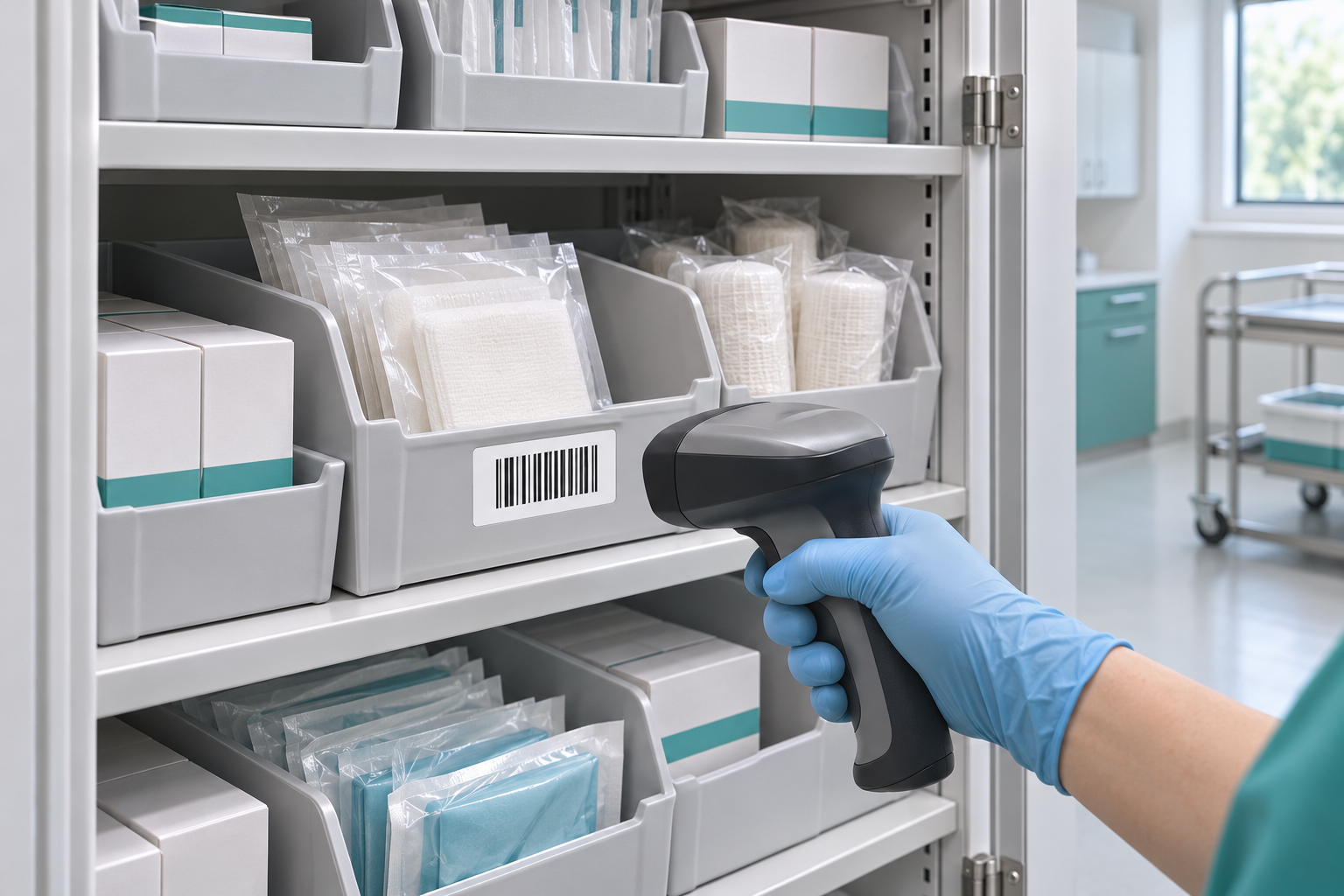
A scan connects an item to the digital workflow. The code can be attached to a storage location, a Kanban card or the product packaging itself. Handheld scanners, mobile data collection devices or suitable smartphones read it. Depending on the application, the scan creates a replenishment request or records a transaction for putting away, removing or returning stock. A manual scan therefore provides structured data for further processing. [2]
Unique identifiers make it easier to match an item to its storage location. A product code can also contain additional information: a GS1 DataMatrix may include a batch number, expiry date or serial number, provided these details are encoded and the software processes them. [3]
In daily use, codes need to be legible and accessible, and devices must support the relevant code types. Maintaining a continuous stock record requires all relevant incoming and outgoing movements to be captured. Device availability, cleaning, batteries, charging stations and responsibility for scanning rounds therefore belong in the implementation plan. If data is transmitted later, users should be able to see which transactions have already been synchronised.
Electronic shelf labels and ordering buttons

A supply request can be triggered directly at the shelf. Electronic shelf labels, or ESLs, display information at the storage location. Where the hardware and software support the relevant button function, a single press can create a supply request. Connected ordering buttons without a display follow the same basic principle. [4], [5]
A display also allows item information to be updated centrally. With the appropriate integration, it can show whether a request is being processed or provide information about delivery status. This helps staff find their way around the storage area and see that supplies have already been requested. [4]
Implementation requires clear storage-location assignments, suitable mounting options and verified wireless coverage. Depending on the architecture, gateways connect the labels to the network. Teams need to agree when a request should be triggered, the replenishment quantity, how repeated button presses are handled and how restocking is confirmed. If a label is to display stock quantities, it needs reliable data from transactions or sensors. Battery replacement and compatibility with the cleaning products used on site also need to be included in ongoing operations.
Scales and weight-based stock monitoring
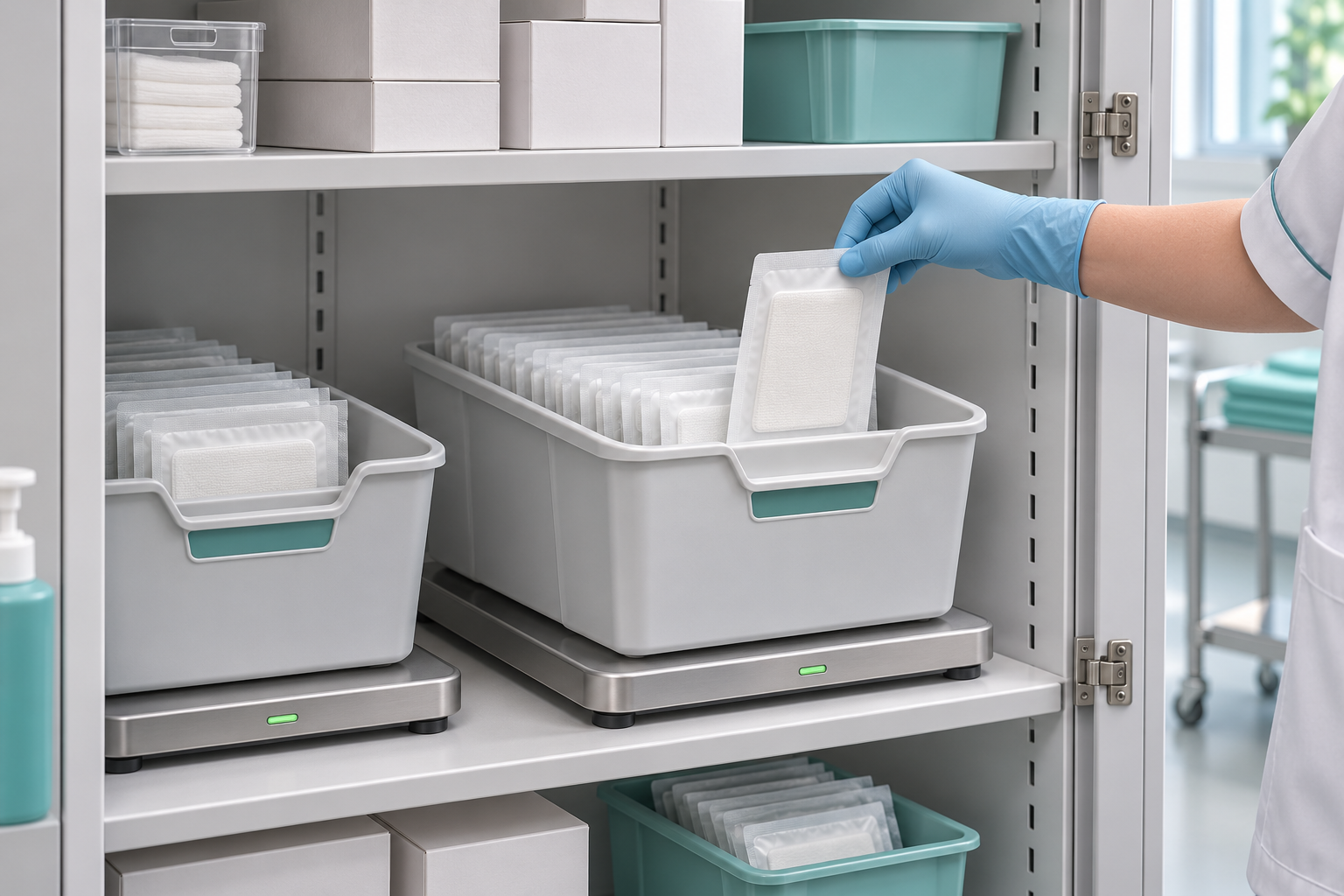
Removing supplies from a bin changes its weight. Connected scales beneath bins or products use this change to record measurements and report demand when defined thresholds are reached. With a known reference weight per unit, software can also calculate a stock quantity. This principle is offered for both industrial materials and medical consumables. [6], [7]
Items being removed or replenished can therefore be detected without an additional action by the user. The measurements make stock patterns visible and support demand-based replenishment.
Reliable results require each measuring location to have an assigned product, a defined empty-bin weight and appropriate weight data. Testing with the actual products shows how the system performs at different fill levels and with different quantities being removed. Measurement resolution, load capacity, a stable installation without interference with the load measurement, and sufficient space beneath the bin all need to suit the application. Supplier discussions should cover packaging changes, variations in unit weight, bin replacement and calibration. It is also worth agreeing separately on the performance promised for weight thresholds and for calculated item quantities.
Sensor-equipped pusher systems
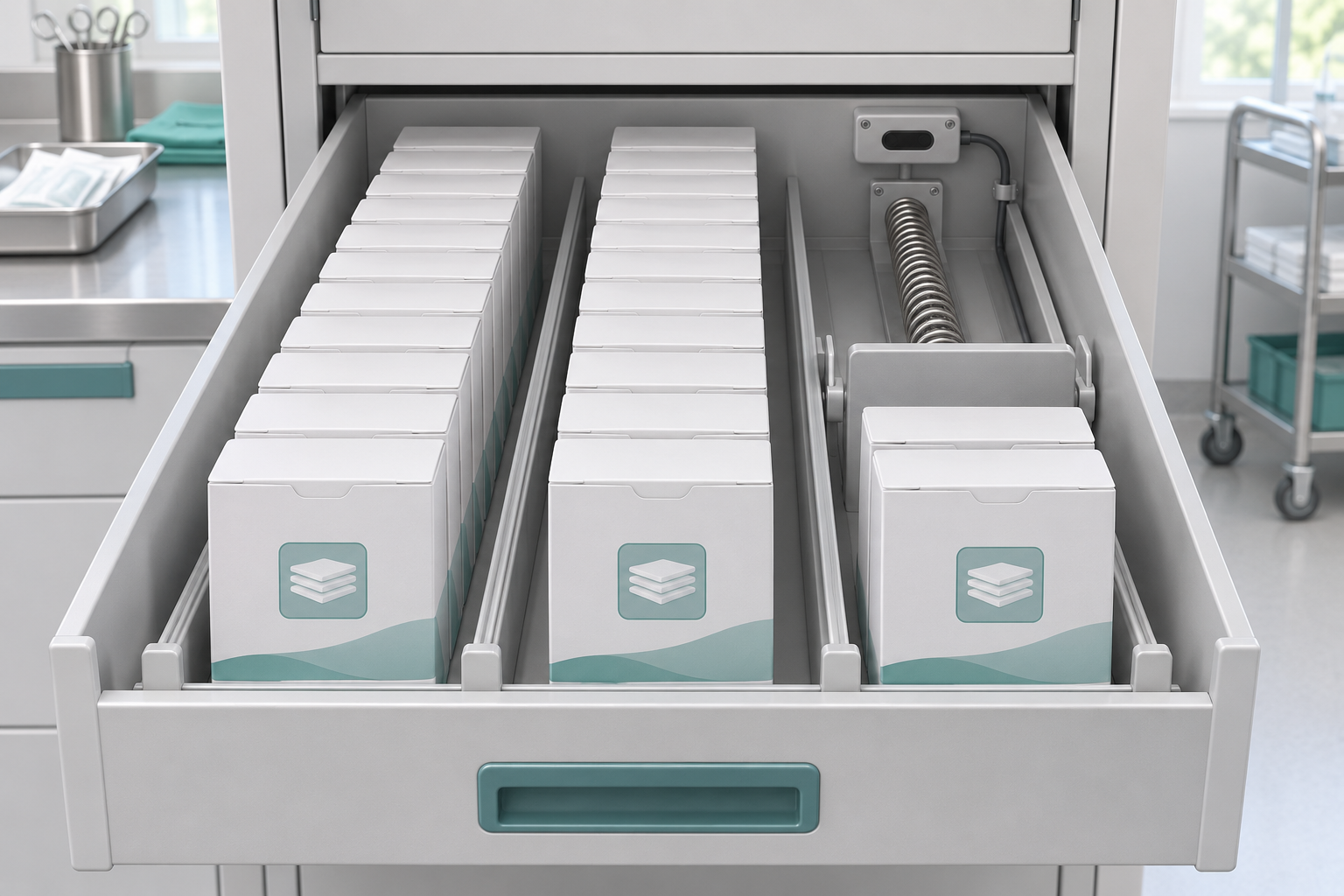
After an item is removed, the remaining packages move forwards. Pusher systems keep products arranged in a row visible and easy to reach. Sensors detect, for example, distances or movements of the pusher. Combined with stored product and packaging data, these measurements can indicate stock changes or trigger replenishment signals. The mechanism that presents the products also provides information for replenishment. [8]
For this to work within a modular storage basket, the packaging shape, dimensions and stability must suit the guide mechanism. Testing with the actual packages is useful, both when the compartment is full and when it is almost empty. Usable width and depth, mounting and access for cleaning also need to be considered.
During an application test, ask the supplier to demonstrate how the system recognises partial withdrawals, returns and restocking, and what quantity accuracy is specified for your products. If a particular picking sequence is required, the restocking process needs to support it. Managing expiry dates requires an additional data and process framework.
Cameras and AI-based image analysis
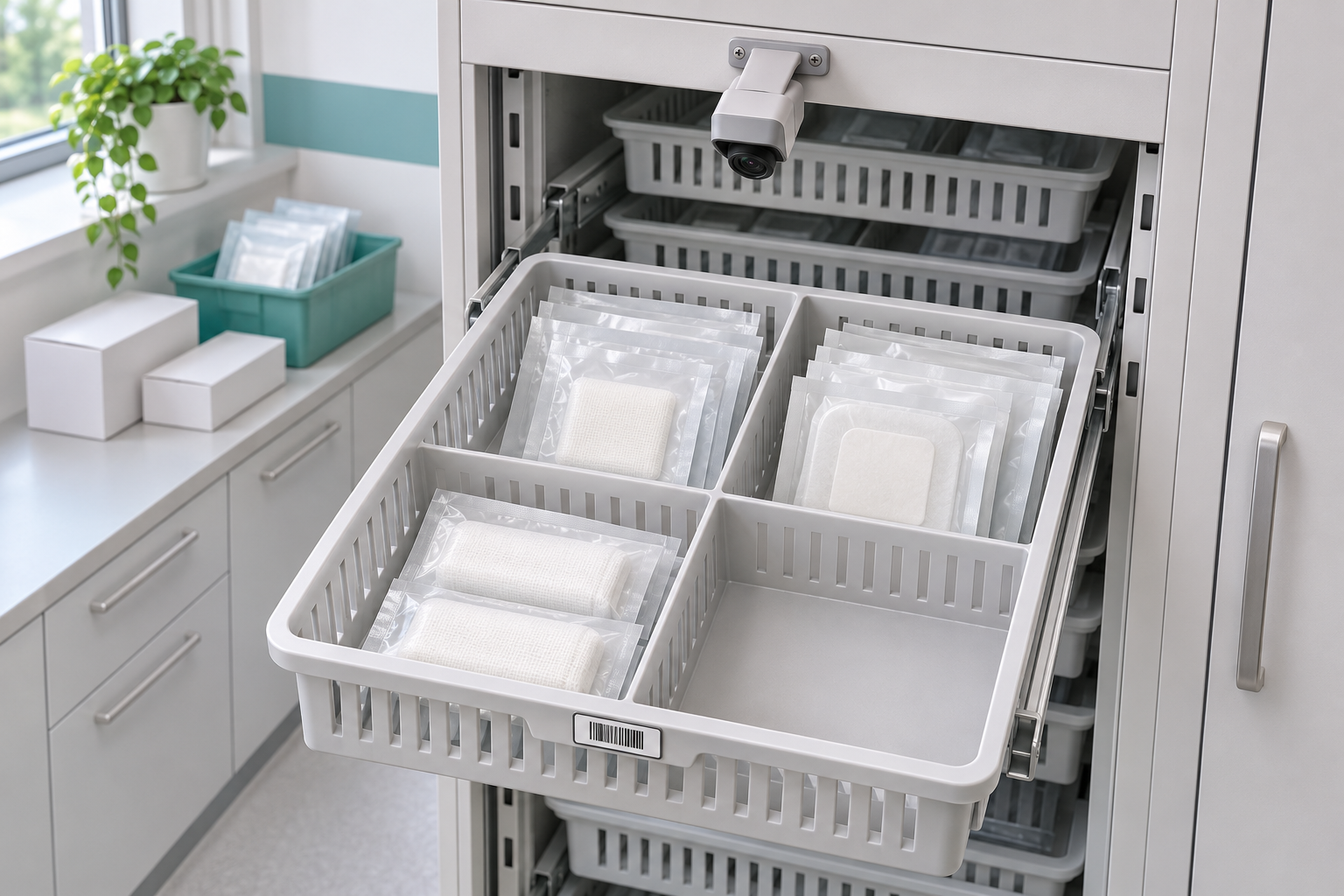
Pulling out a modular storage basket makes its contents visible. An approach documented by Fraunhofer IML uses precisely this moment: a camera captures the basket, identifies it through a code and detects empty compartments. The stored assignment between compartment and product allows a supply request to be generated. Images are analysed directly on the device. [1], [9]
The normal act of taking supplies can therefore also trigger digital demand detection. A camera can capture several visible compartments, while local processing allows only the required information to be passed on.
Planning needs to cover the mounting position, lighting, a clear view of the compartments and accurate product assignments. Test detection using the actual supplies, typical hand movements and different fill levels. The objective should be explicit: detecting empty compartments, classifying fill levels or determining quantities. This calls for measurable detection criteria, rules for ambiguous images and an agreed approach to data protection. For any specific proposal, availability, operational references and support after implementation should also be demonstrated.
RFID Kanban with cards or bins
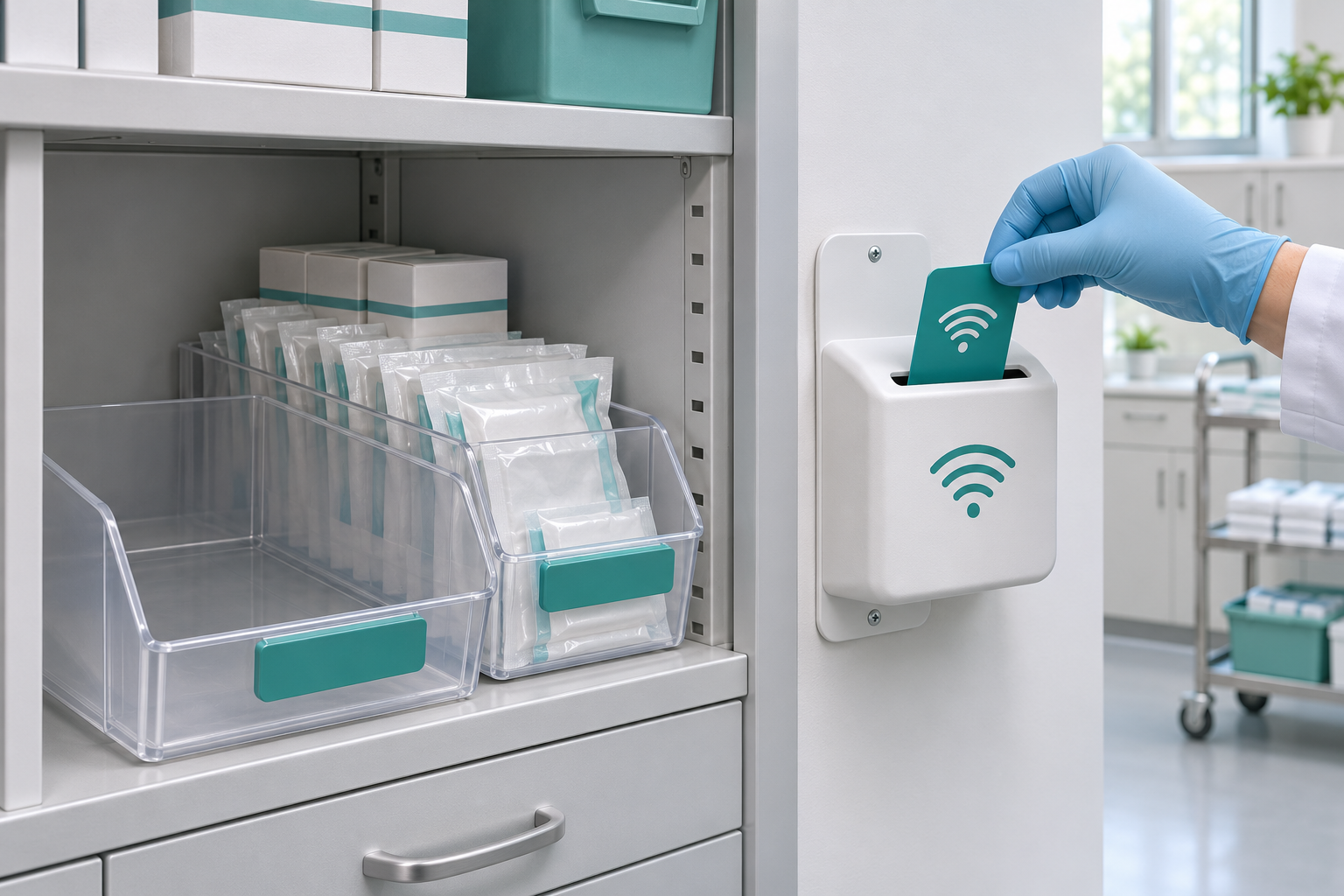
A card goes into a reader box; an empty bin is placed on a reading surface. In RFID Kanban systems, actions like these can trigger a supply request. Cards or bins carry a transponder whose identifier is read wirelessly. Once the defined replenishment point is reached, this action initiates the assigned request. [10], [11]
Reordering becomes part of the familiar bin cycle. Suitable systems can read several identifiers together. Individual products do not need their own tags for this approach.
The complete cycle needs to be planned: clear assignments between cards, bins, storage locations and replenishment quantities; accessible reading and collection points; and the return process after delivery. Repeated readings, lost cards, urgent requirements and outstanding requests should also be discussed with the supplier. Here, the RFID signal represents a Kanban event. Tracking the stock of individual products requires a process designed to capture that additional information.
Item-level RFID and intelligent cabinets
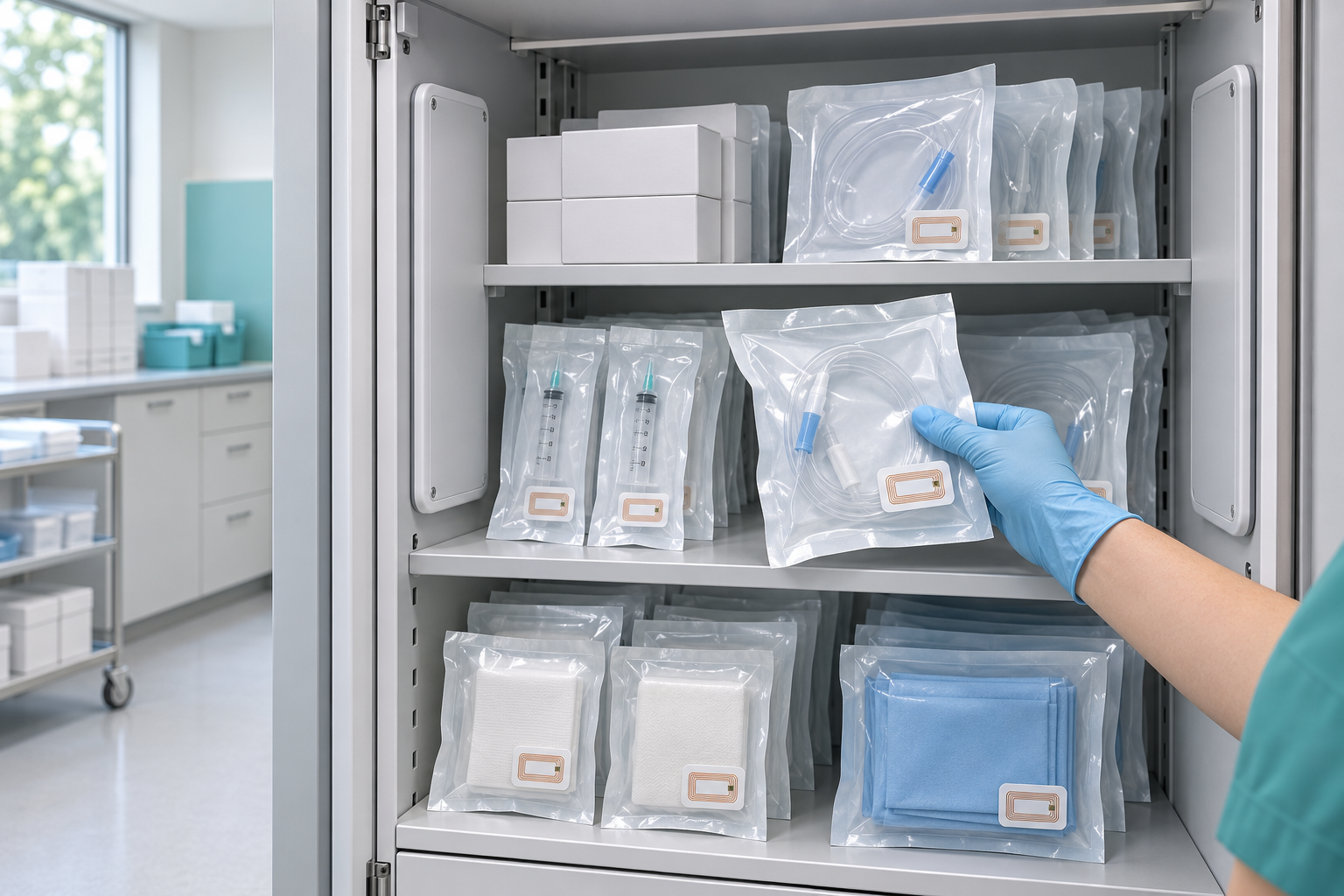
With this approach, each individual package receives a unique wireless identifier. Suitable cabinets or reading stations detect the tagged units and their movements. Associated master data can also provide batch numbers, serial numbers or expiry dates. [12]
This makes it possible to establish which packages belong to the stock. It can support consignment inventory, the provision of higher-value supplies and product traceability. Where the necessary movements are captured, replenishment processes can also be built on this information.
Before implementation, agree who will attach the tags and maintain the associated data. Reading tests should take place in a fully stocked cabinet containing the intended product range. Liquids and environments containing metal make the selection and positioning of transponders and antennas particularly important. [13] Withdrawals, returns, transfers and actual consumption also need to be clearly distinguished. The same applies to access control: a staff badge identifies the person opening a cabinet. A separate detection function establishes which supplies were removed.
Other shelf sensors for presence and fill-level detection
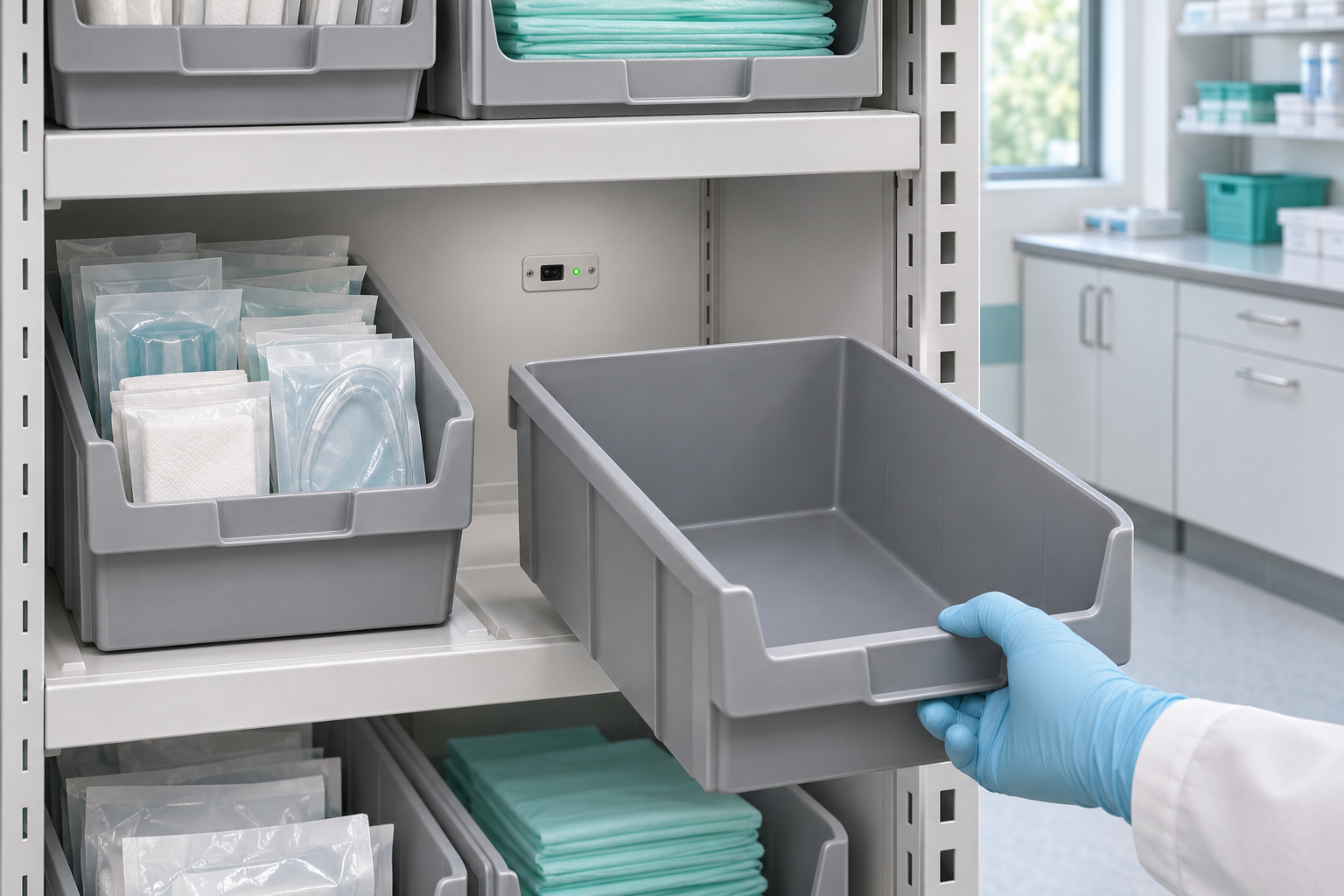
A change at a storage location can also provide a replenishment signal. Sensors can detect, for example, whether a bin is present or whether a distance has changed. One approach documented in industrial Kanban supply uses optical detection to recognise when a bin is removed from its assigned location and trigger replenishment. [14]
The benefit lies in linking a defined change of state directly to a digital notification. Sensors can therefore be incorporated into an established bin and replenishment workflow.
When choosing a solution, be clear about which event is measured and what it means for the supply process. For removal detection, this includes defining when a bin should be taken off the shelf. Hospital use requires the product range, mounting, cleaning and operating conditions to be assessed. Optical and distance-based solutions should be tested with the intended layout and the actual stored products. Also agree explicitly whether the supplier provides a demand signal or a reliable quantity measurement.
Dispensing machines and electronically controlled dispensing cabinets
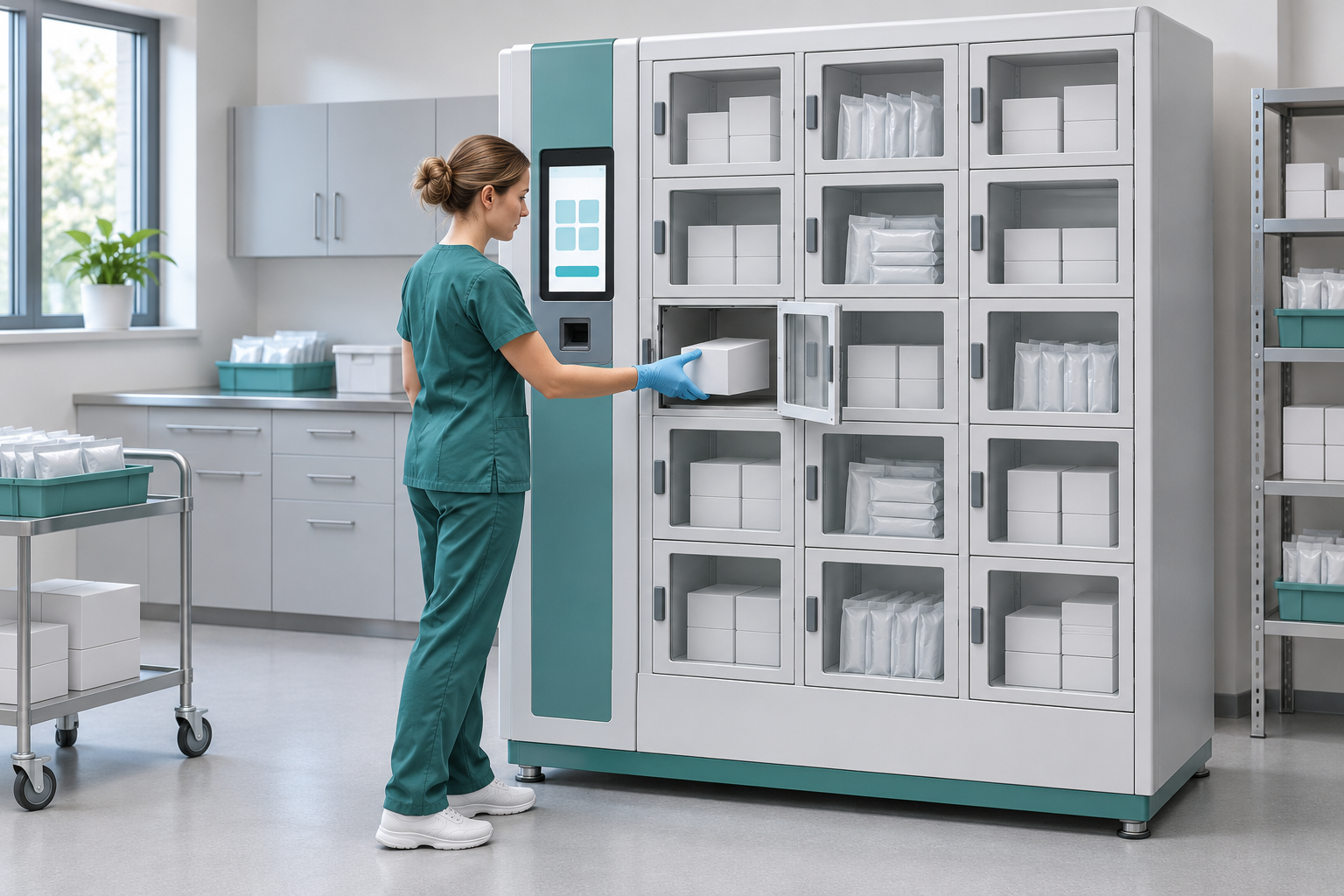
Select the supplies, identify yourself if required, and take the items: dispensing machines combine product availability with controlled access. Depending on the design, individual compartments or drawers open, or a mechanism dispenses individual items. The software records the defined dispensing transactions and can report replenishment needs. [15]
This makes supplies accessible at different times according to defined permissions. Assigning a dispensing transaction to a cost centre or individual also provides a basis for planning the product range and replenishment.
The right configuration depends on the dimensions, weight and sensitivity of the packaged products. Planning should include floor space, room for operation and maintenance, power, network connectivity and restocking. Test how the system works when several people need access at the same time, as well as when access is urgent. Clarify what the system records: a confirmed individual withdrawal, a measured quantity change or a manual transaction. Sterile, temperature-controlled and pharmaceutical products each require suitable storage conditions and separately agreed processes. Suitability for the specific product range and intended area should be demonstrated.
Additional elements of automated hospital logistics
Light guidance, voice guidance and smart glasses

A light indicates the picking location; a voice instruction or smart glasses guide the user through an order. Digital assistance supports order picking. Pick-by-Light identifies where to collect an item, while Put-to-Light helps staff put away or distribute supplies. Guided steps can be linked to transactions or confirmations. [16]
For staff to benefit, the system needs unambiguous storage addresses and current order data. Depending on the technology, application testing should consider visibility, ambient noise, wearing comfort, cleaning and operation with gloves. Whether stock records are also updated depends on the connected transactions or sensors.
Vertical lift modules, carousels and automated retrieval
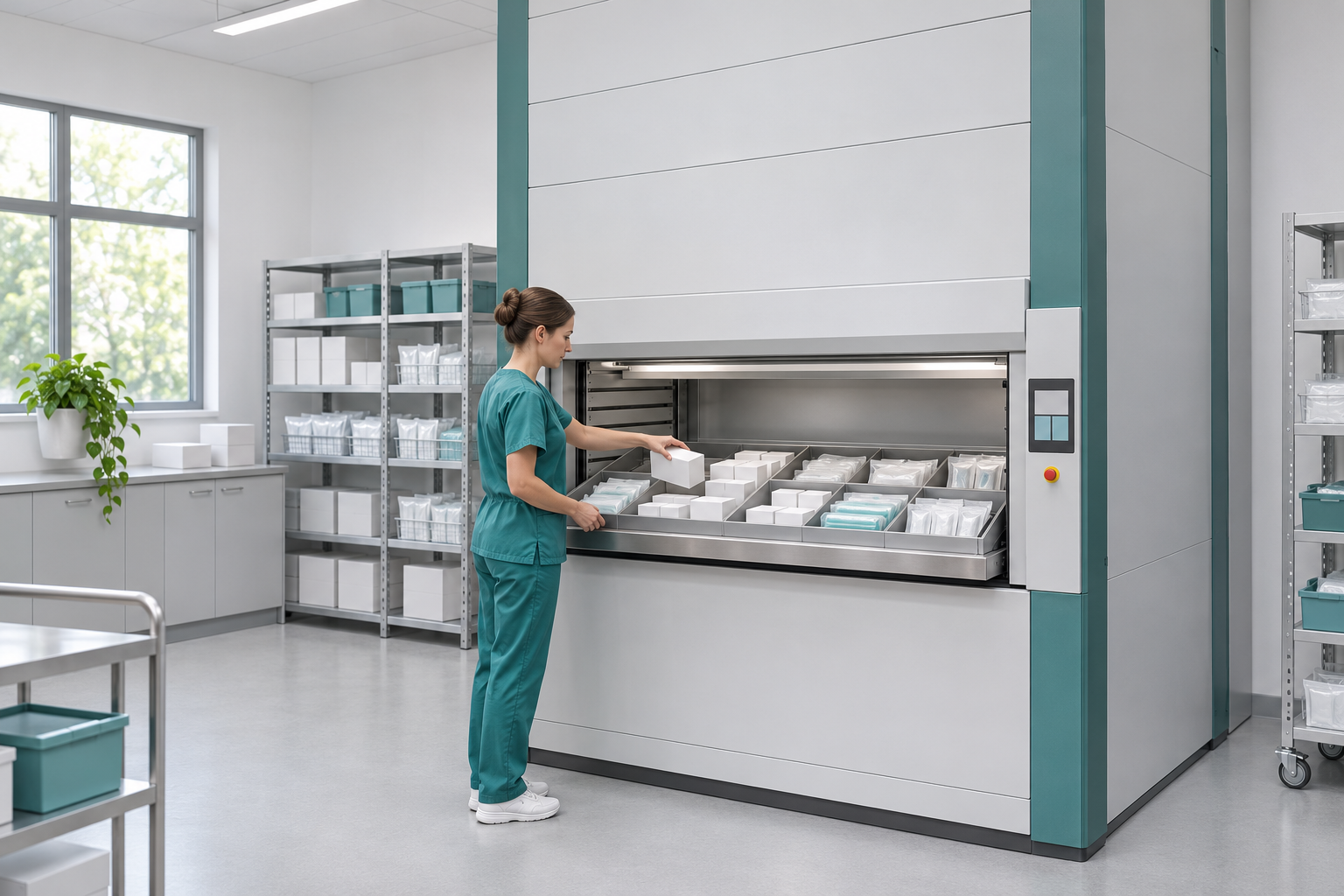
In automated storage systems, the requested storage location is brought to the access opening. This supports picking in the central warehouse or suitable decentralised areas and makes use of available room height. Documented hospital applications range from pharmacies to the provision of operating theatre supplies. [17]
System design needs to consider product dimensions and retrieval speed alongside room height, floor load capacity and installation access routes. Power, maintenance access and the connection to warehouse management also matter. A proposal should make clear which steps the equipment performs and how the retrieved supplies subsequently reach the ward storage modules.
Automated goods transport in hospitals
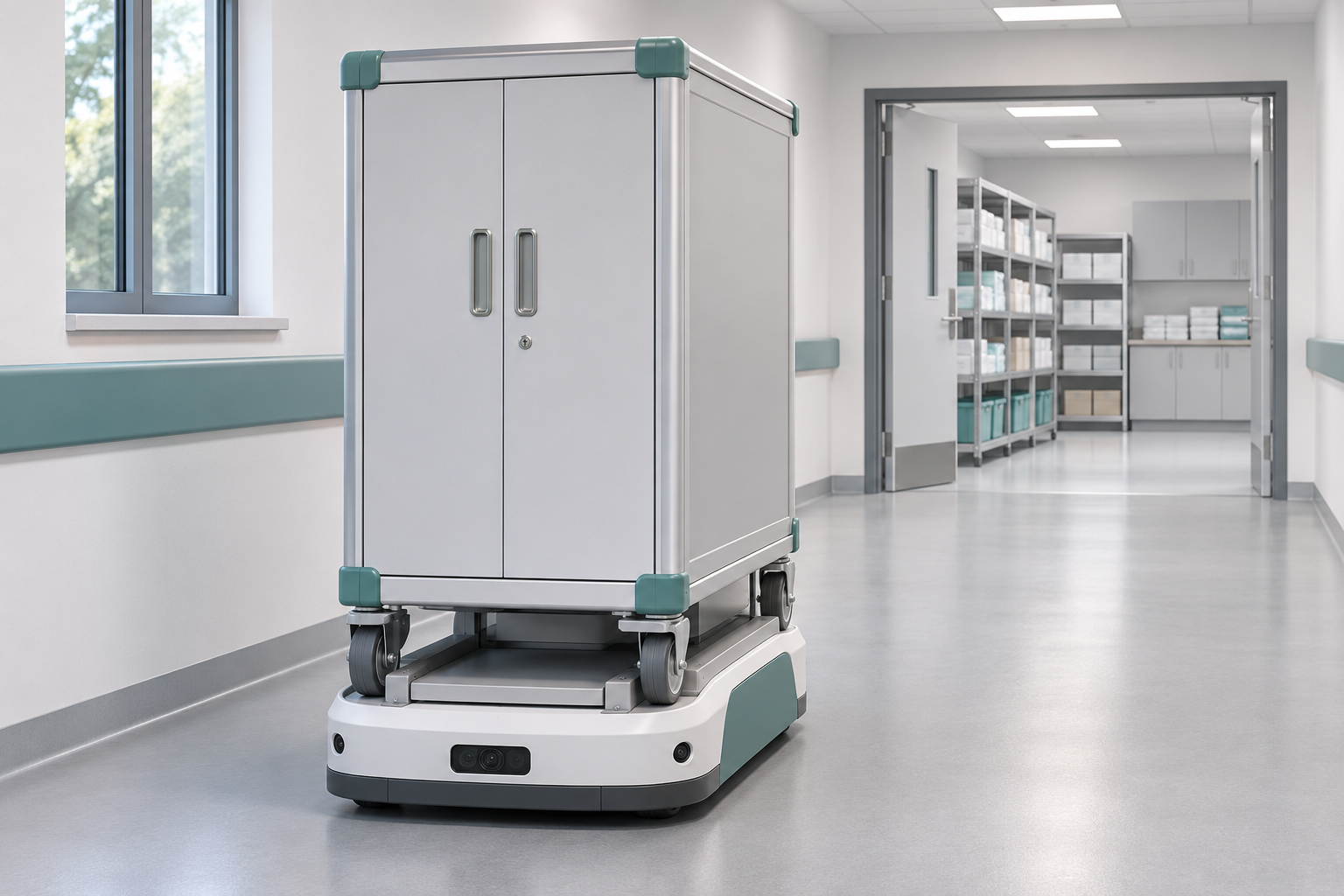
Once supplies have been requested, they still need to reach their destination. Automated guided vehicles, autonomous mobile robots and other automated goods transport systems can cover routes between the warehouse, handover points and clinical areas. They add the physical flow of goods to digital demand capture. [18]
Automated hospital transport requires suitable routes and transport containers, handover areas and charging locations. Depending on the building, doors and lifts may need to be integrated, and traffic and hygiene arrangements agreed. Responsibility for loading, receiving deliveries and putting supplies away remains part of the plan. The agreed scope should therefore make clear whether the service ends at the ward handover point or also includes automatic restocking of the modular cabinet. [19]
Digital inventory planning and consumption forecasting
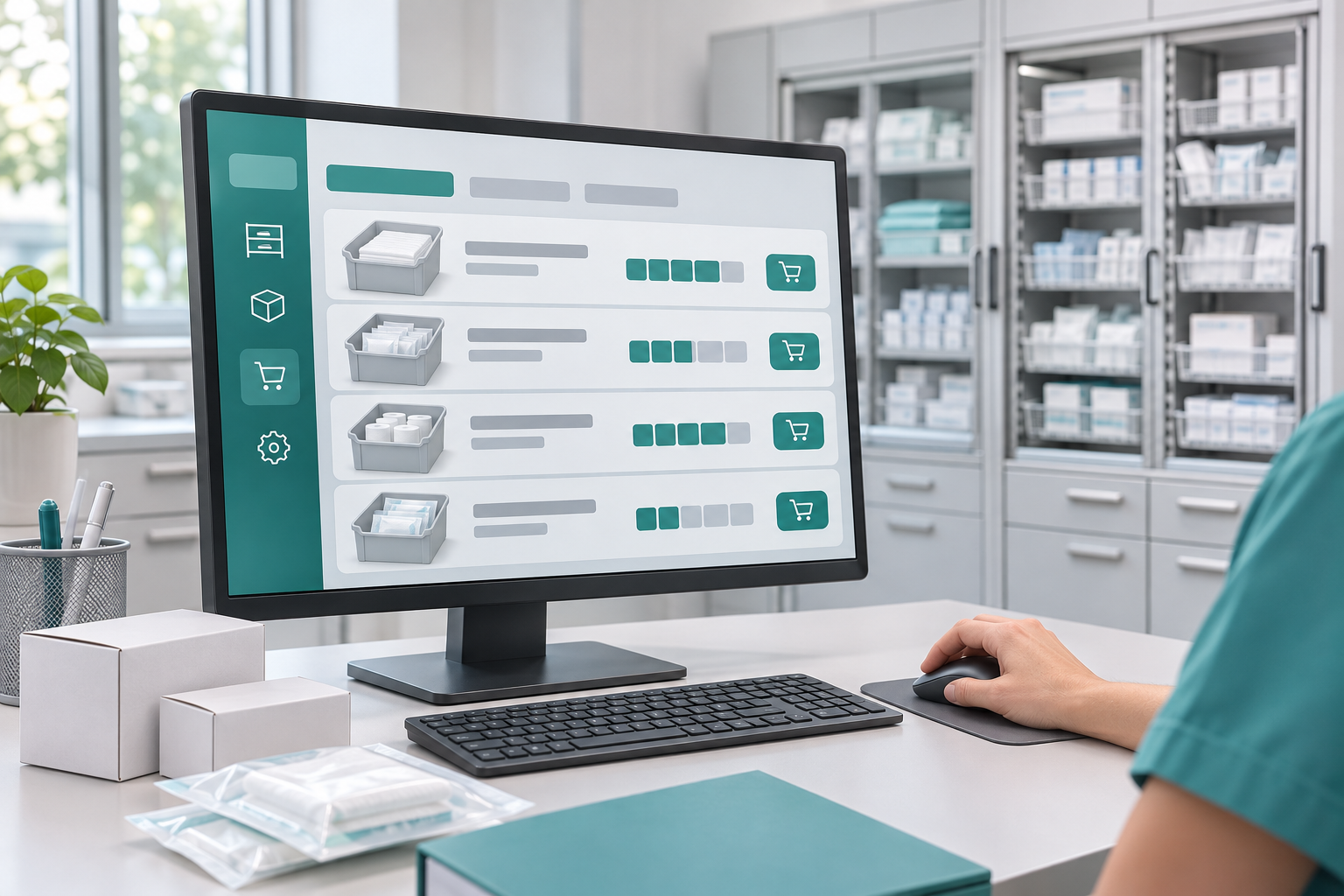
Supply requests and material movements create a data foundation for further planning. Software can bring this information together, analyse stock patterns and support adjustments to reorder points, replenishment quantities and delivery schedules. This requires reliable data on quantities, movements and lead times. The sizing of modular storage cabinets should also account for the product range and replenishment frequency. [20]
When evaluating forecasting functions, examine their basis: Which data is used, and how are changes in hospital operations taken into account? What matters is the demonstrable value of the recommendations in the hospital’s own supply process. It is also necessary to define which adjustments may happen automatically and which require approval.
What hospitals should consider when implementing a solution and selecting a supplier
A shared description of the required workflow makes proposals easier to compare. The following points help procurement and logistics teams turn technical functions into a process that works in their hospital.
Define the product range and required information
Start with the products: Which items need to be supplied, to which locations and in which units? Individual packages, cartons and complete bins need clearly defined quantity relationships. This establishes whether a timely demand signal is sufficient or whether stock quantities, batches, expiry dates and individual packages must also be recorded.
When defining a reorder point, consider the time until the storage location has actually been refilled. Order cut-off times, weekends and agreed reserves all belong in this calculation. This connects technical demand detection with the capacity of the replenishment process.
Check space and infrastructure on site
A site visit makes the requirements tangible: How much cabinet space and room for movement are available? Where can components be mounted? Will devices or bins require additional space? Connectivity depends on the architecture and may involve Wi-Fi, other wireless technologies, gateways, wired connections or mobile networks.
Wireless and network coverage should be checked under realistic conditions, including with cabinet doors closed. Ask for the power supply, battery concept, data transmission intervals and required network permissions to be documented. Compatibility with the intended cleaning and disinfection routines is also part of technical suitability.
Follow the interfaces through to the status feedback
Walking through a complete process shows how the systems work together: from the initial signal through processing and any approval, to delivery and confirmed restocking. It must be clear which system maintains product master data, storage locations and quantities, and which system receives the request.
Also discuss status updates, substitute products, partial deliveries and requests already in progress. Documented data formats and existing interfaces for the software version in use make the integration requirements concrete. Clear responsibilities, configuration, testing and later interface changes should also be included in the agreed scope.
Plan for operation beyond implementation
Products change, master data needs updating and technical notifications need attention. Named owners are required for these tasks and for replenishment. Ask the supplier to demonstrate a connection interruption as well: How does it become visible? Which events are stored? How does transmission resume afterwards? Requests that have already been processed should remain traceable.
A practical fallback procedure, accessible support, spare parts and agreed response times complete the operating concept. Access permissions, software maintenance, data processing and any analysis involving personal data should be agreed with the responsible teams within the hospital.
Agree on scope and total costs transparently
References are particularly useful when the product range and operating conditions are comparable. A pilot using the hospital’s own products and involving the future users makes performance assessable. Agree on criteria in advance, such as correctly recorded events, the time until a request reaches the target system and the effort required for restocking.
The financial assessment should bring together hardware, installation, interfaces, software, training, maintenance and internal operating tasks. Depending on the technology, batteries, transponders or other consumables may also be required. Further questions belong in the proposal: Does the offer depend on a particular supply contract? How can additional wards be added? How can data be exported if the hospital later changes systems?
How a pilot can produce meaningful results
A clearly defined area with a representative product range provides a manageable starting point. First, record the existing process from recognising demand to completing restocking. This baseline will later show where changes have occurred.
Useful measures include:
- Time spent checking stock, requesting supplies, resolving issues and putting items away.
- Availability of supplies, unplanned replenishment and time spent searching.
- Correctly recorded requests or stock changes.
- Stock quantities and, where relevant, expired items.
- Ease of use from the perspective of nursing staff, supply assistants and logistics teams.
- Ongoing administrative and technical effort.
If occupancy, the product range or delivery conditions change during the pilot, include this in the assessment. This keeps the results understandable. A pilot can also show how several technologies work together. The key is whether their data and tasks come together in a coordinated supply process.
Frequently asked questions about automated hospital supply replenishment
Can existing modular storage cabinets still be used?
Many approaches can be added to existing storage locations. Testing the actual cabinet will show whether the combination works: dimensions, mounting, accessibility and cleaning need to be compatible with the selected technology.
Does automated supply replenishment require Wi-Fi everywhere?
Connectivity depends on the architecture. Options include wireless devices connected through a central gateway, as well as wired or mobile network connections. The operating concept needs to explain how data is transmitted and what happens if the connection is interrupted.
Does an automatic request also mean an automatic order to an external supplier?
The hospital defines what happens after the signal. The first step may be an internal request, a shopping basket or an approval. Warehouse organisation, interfaces and ordering rules determine what follows.
Can several technologies be used together?
Yes. Different capture methods can, for example, feed into the same request process. This requires coordinated data and workflows, unique product and storage-location identifiers, and rules to prevent duplicate requests.
Which technology is suitable for a particular hospital?
Start with the desired workflow: reporting demand, recording quantities, identifying individual products or dispensing supplies under controlled conditions. This determines the information required. The product range, space, infrastructure and operating arrangements then shape the selection. Testing with the hospital’s own supplies shows how the approach can work in practice.
Sources
Technical functions vary depending on the configuration and integration. The linked product documentation provides evidence of specific operating principles, rather than a general performance guarantee for every system within a technology category. Supplier documentation reflects the respective product perspective and does not replace an independent comparative study. The selection and pilot questions are editorial recommendations derived from these operating principles and process planning.
Research conducted: 19 November 2026. Sources and links last checked: 21 November 2026.
[1] Fraunhofer IML, Künstliche Intelligenz im Krankenhaus – Fokus Logistik, December 2023. Section “Bestandsführung – KI zur automatischen Materialanforderung für Modulschränke”, PDF page 12. White paper, in German
[2] Product documentation on scanner-based inventory management and replenishment in operating theatres. Technical description, in German
[3] GS1, data elements and scanning technology for GS1 DataMatrix in healthcare. Standards information
[4] Product documentation on electronic labels with an ordering button and status display. Technical description, in German
[5] Technical application examples for connected ordering buttons. Application overview, in German
[6] Product documentation on weight-based inventory management in healthcare. Technical description, in German
[7] Product documentation on weighing systems for industrial Kanban replenishment. Operating principle, in German
[8] Product documentation on sensor-equipped storage containers with pusher mechanisms. Technical description, in German
[9] Thomas Bredehorn / Fraunhofer IML, Impuls: AI4Demand. Presentation at the hospital procurement congress in Berlin, 14 May 2024; particularly slides 6–9. Presentation, in German
[10] Technical product data sheet on RFID Kanban cards and reading stations for hospital supply replenishment, hosted in the GS1 UK partner section. Product data sheet (PDF)
[11] Product documentation on RFID reading and collection points for Kanban. Technology options, in German
[12] Product documentation on identifying individual implant packages in RFID cabinets. Technical workflow, in German
[13] GS1, the effects of metal and liquids on RFID and the use of suitable transponders. Technical guidance
[14] Product documentation on optical detection of bin removal in industrial applications. Operating principle
[15] Product documentation on dispensing machines for hospital consumables. Application and configuration, in German
[16] Fraunhofer IML, Digitale Assistenzsysteme in der Logistik, issue 22, 15 December 2021; particularly the sections on mobile and stationary assistance systems. White paper, in German
[17] Application documentation on automated storage systems in hospitals. Application overview, in German
[18] Product documentation on automated guided vehicles in hospitals. Functional description
[19] Fraunhofer IML, Logistik entdecken, issue 25/2024. Article on transport robots in hospitals and the 5G-RemRob research project, PDF pages 53–54. Publication, in German
[20] Fraunhofer IML, sizing of the modular cabinet supply system at Münster University Hospital. Project description, in German